Dievio
What "Intent-Driven" Actually Means for an Agency Lead List
Most agency lead list requests start the same way: "We need 2,000 contacts in SaaS, 50 to 500 employees, VP of Marketing and above." That is a firmographic brief. It describes who could buy. It says nothing about who is currently in a buying window, who just hired a demand gen leader, who is reading comparison pages, or who started a free trial last week.
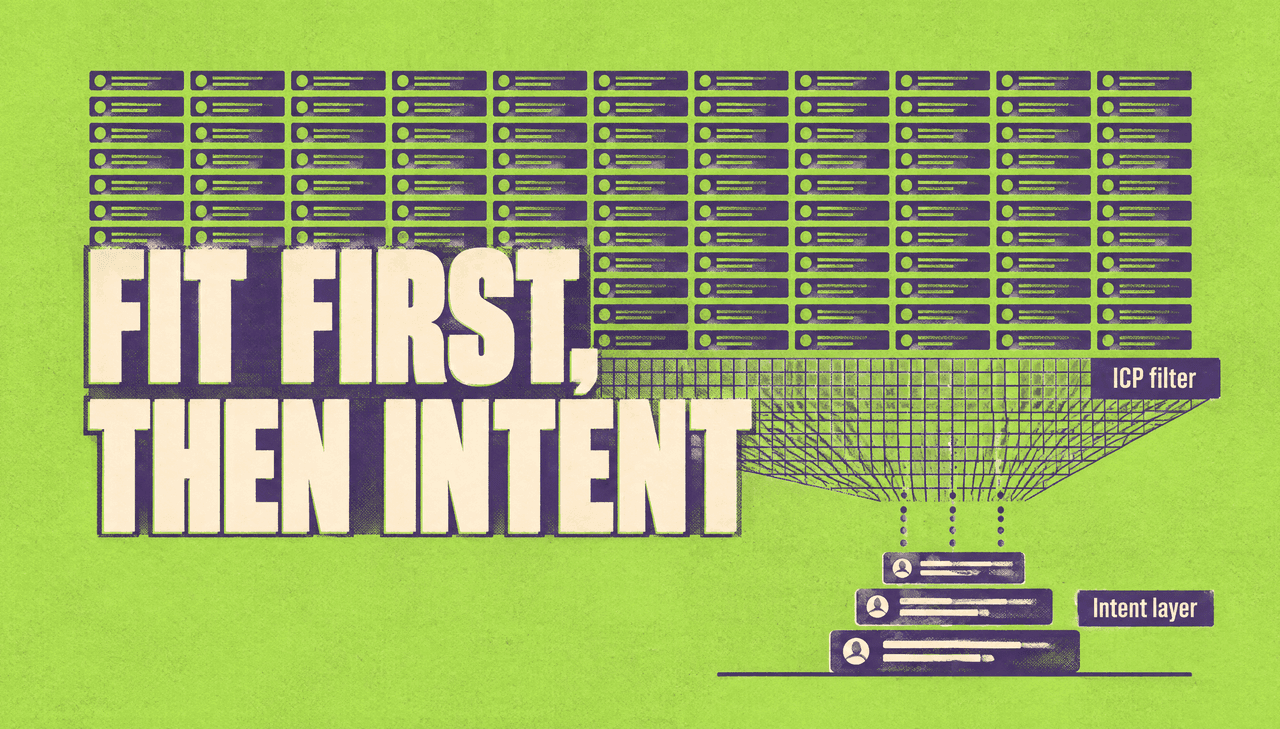
An intent-driven lead list keeps the firmographic base but adds a second dimension: observable signals that an account is actively researching, evaluating, or preparing to buy something in your client's category. The list is no longer a flat export. It becomes a ranked, tiered asset where the top of the file is reserved for accounts that match the client's ICP and show evidence of in-market behavior.
For agencies, this distinction matters commercially. A flat firmographic list is a commodity — the client can buy it themselves. A tiered intent-driven list is a strategic deliverable. It comes with a rationale, a scoring model, and an outreach sequence mapped to signal strength. That is the difference between selling data and selling campaign performance.
This guide is written for the operator building the list, not the strategist presenting the deck. It covers which intent categories are actually usable in agency workflows, how to segment accounts by ICP fit and intent strength, how to score and sequence contacts, and how to deliver and QA the file inside a recurring client cadence.
Why Firmographic-Only Lists Underperform in Client Campaigns
Firmographic-only lists fail for predictable, structural reasons. None of them are about data quality in the narrow sense — the emails can be perfectly valid and the campaign can still underperform.
- Volume without timing. A list of several thousand well-fit accounts typically contains only a small fraction of accounts that are in an active buying window at any given moment. The rest are cold-but-qualified. Blasting the full file at once dilutes reply rates and burns the client's domain reputation.
- Fit and in-market behavior are different variables. A company can match every ICP filter and have zero internal initiative to change vendors this quarter. Firmographics describe capacity to buy; intent describes readiness to buy.
- Wasted credits and wasted SDR hours. Every contact exported costs credits. Every contact sequenced costs SDR time. If a large share of the file is cold, the agency is effectively subsidizing the client's prospecting with low-yield activity.
- Reporting collapses. When reply rates sit in the low single digits, the agency has no story to tell. With intent tiers, the agency can show that Tier 1 accounts consistently outperform Tier 3 on reply and meeting rates — which reframes a flat result as a targeting problem the agency can solve.
HubSpot's guidance on sales prospecting makes a related point: prospecting quality depends on identifying accounts with a reason to engage now, not just accounts that fit a profile. Intent data is how agencies operationalize that "reason to engage now" at list scale.
The Three Intent Data Categories Agencies Can Use
Not all intent data is equal, and agencies rarely have access to all three categories at once. Understanding the tradeoffs prevents over-claiming signal strength to clients.
First-Party Intent
This is data the client already owns: CRM activity, product usage, website visits, content downloads, email engagement, support tickets, trial signups. It is the highest-fidelity intent available because it reflects real behavior with the client's brand.
Agency use case: Best for expansion campaigns, re-engagement of closed-lost accounts, and ABM plays where the client has meaningful web traffic. The limitation is coverage — first-party intent only exists for accounts that already know the client exists.
Third-Party Intent
Third-party intent comes from external networks that observe research behavior across thousands of publishers, review sites, and content properties. It surfaces accounts showing topic-level surges — for example, a spike in research around "revenue operations software" or "payment orchestration."
Agency use case: Best for net-new prospecting where the client needs to reach accounts that have never touched their site. The limitation is interpretation: a topic surge tells you an account is researching a category, not that they are evaluating your client specifically. It also decays fast — a surge from six weeks ago is often worthless.
Contextual and Behavioral Signals
These are observable events that correlate with buying readiness: funding rounds, executive hires, job postings for roles that imply a new initiative, tech stack changes, review site activity, conference sponsorships, and product launches.
Agency use case: Best for trigger-based campaigns and for adding a "why now" line to cold outreach. The limitation is that these signals are noisy in isolation — a single job posting is weak evidence, but three related signals in the same month is a strong pattern.
| Intent Category | Example Signals | Latency | Coverage | Best Agency Use |
|---|---|---|---|---|
| First-party | Website visits, trial signups, content downloads, CRM activity | Real-time to daily | Low (only known accounts) | Expansion, re-engagement, ABM |
| Third-party | Topic surges, publisher research, review site activity | Weekly to monthly | High (broad account coverage) | Net-new prospecting, category-level targeting |
| Contextual / behavioral | Funding, hiring, tech stack changes, exec moves | Days to weeks | Medium | Trigger campaigns, "why now" personalization |
ICP Plus Intent Segmentation Framework
The core of an intent-driven list is a two-axis segmentation: ICP fit and intent strength. Every account in the file falls into one of four quadrants, and each quadrant maps to a different outreach motion.
| Segment | ICP Fit | Intent Strength | Definition | Outreach Motion |
|---|---|---|---|---|
| Tier 1 | High | High | Strong firmographic match plus multiple recent intent signals | Immediate multi-threaded outreach: email + LinkedIn + call within 72 hours |
| Tier 2 | High | Medium | Strong firmographic match, one or two moderate signals | Sequenced nurture with category-relevant content, 2–3 week cadence |
| Tier 3 | High | Low | Strong firmographic match, no current signals | Long-term drip, quarterly re-check, content-led touchpoints |
| Nurture / Exclude | Low | Any | Weak firmographic match regardless of intent | Exclude from campaign or route to a separate low-priority track |
Two rules keep this framework honest. First, intent never overrides ICP. A low-fit account with a strong topic surge is still a low-fit account — it belongs in a separate test segment, not in the client's core campaign. Second, Tier 1 should be small. If 40% of the file is Tier 1, the scoring model is too loose and the tier loses meaning.
Before any of this segmentation happens, the client ICP itself needs to be validated. A weak ICP produces a weak intent layer on top of it. The client ICP validation workflow covers how to pressure-test firmographic criteria and confirm that the base list is built on solid ground before intent scoring is layered on top.
Building the Intent-Driven List: A Step-by-Step Workflow
This is the operational sequence. It assumes the agency has access to a firmographic lead search tool and at least one intent source, whether first-party from the client or third-party from a data provider.
Step 1: Confirm the Client ICP
Lock the firmographic filters before touching intent data. Industry, employee count, revenue band, geography, tech stack, and title hierarchy. Document the filters in a shared spec so the next list drop uses the same base. If the ICP is fuzzy, intent data will amplify the fuzziness rather than fix it.
Step 2: Pull the Firmographic Base List
Build the base list using lead search with firmographic filters. Keep this list intentionally broad — it is the universe of accounts that could plausibly buy. Do not apply intent filters yet. You want to see the full addressable set before narrowing.
Step 3: Layer the Intent Signal
Match the base list against the intent source. For third-party intent, this usually means uploading the domain list to the intent provider and pulling back account-level scores. For first-party intent, it means joining against the client's CRM or product analytics export. For contextual signals, it means enriching each account with recent trigger events.
Match rates matter here. If only 30% of the base list matches against the intent source, the resulting file will be thin. Document the match rate and flag it to the client before delivery.
When match rates fall below 50%, the agency has three options. First, expand the firmographic base to include more accounts — a broader universe produces more matches even if the match rate stays the same. Second, switch or supplement the intent source — different providers cover different account sets, and combining two sources can lift coverage materially. Third, accept a smaller file and adjust campaign expectations — a 200-account Tier 1 segment is still valuable if those 200 accounts are well-qualified, but it changes the outreach math.
The worst option is to lower the intent threshold to inflate tier sizes. A Tier 1 segment padded with weak signals performs no better than a flat firmographic list and erodes client trust in the scoring model.
Step 4: Score and Tier
Apply the scoring model (covered in the next section) to assign each account a composite score, then bucket accounts into Tier 1, Tier 2, Tier 3, or Nurture. The output is a single file with a tier column and a score column.
Step 5: Validate Segment Counts
Before exporting, check the size of each tier. Use preview lead counts before exporting to confirm that Tier 1 has enough contacts to run a campaign and that no tier is accidentally empty. If Tier 1 is under 50 contacts, either the intent threshold is too strict or the base list is too narrow.
A useful sanity check: as a rough heuristic, Tier 1 often represents roughly 10–20% of the matched file, Tier 2 another 20–30%, and the remainder split between Tier 3 and Nurture. These are guidelines, not rules — the right distribution depends on the client's market and the strength of available intent data. But if Tier 1 is 60% of the file, the scoring model is not differentiating. If Tier 1 is 2% of the file, the threshold is too aggressive or the intent source is too narrow.
Step 6: Export and Route
Export each tier as a separate file or a separate view, with the tier label attached to every row. Route Tier 1 to the immediate sequence, Tier 2 to the nurture sequence, and Tier 3 to the long-term track. Never mix tiers in a single sequence — it destroys the ability to measure tier-level performance.
Scoring and Prioritization Logic
Scoring is where most agency intent workflows break down. The temptation is to build a complex weighted model that no one can explain to the client. A simpler model that the client understands and trusts is more valuable than a sophisticated one they cannot audit.
A workable scoring approach uses three components:
- Firmographic score (0–40 points). Based on how closely the account matches the ICP. Perfect match on industry, size, and geography scores highest. Partial matches score lower.
- Intent score (0–40 points). Based on the number, recency, and strength of intent signals. Multiple recent signals score higher than a single old signal. Recency is weighted heavily — a signal from the last 14 days is worth more than a signal from 60 days ago.
- Contact-level fit (0–20 points). Based on whether the specific contact holds a role that matches the buying committee. A VP of Marketing at a Tier 1 account scores higher than a Marketing Coordinator at the same account.
LinkedIn's definition of lead scoring emphasizes that scoring should reflect both fit and engagement — the same principle applies here, with intent data standing in for engagement at the account level.
Once scored, map the tiers to outreach sequencing:
| Tier | Score Range | Sequencing | Cadence | Channel Mix |
|---|---|---|---|---|
| Tier 1 | 75–100 | Immediate multi-threaded | First touch within 72 hours | Email + LinkedIn + call |
| Tier 2 | 50–74 | Sequenced nurture | 2–3 week cadence | Email + LinkedIn |
| Tier 3 | 30–49 | Long-term drip | Quarterly re-check | Email content only |
| Nurture | Below 30 | Excluded or separate track | N/A | N/A |
One caution: do not over-weight a single signal. A funding round alone is not a buying signal — it is a capacity signal. A funding round plus a job posting for a role that owns the problem your client solves is a buying signal. The scoring model should reward signal combinations, not individual events.
Two additional refinements strengthen the model. First, apply decay weighting explicitly — a signal from the last 14 days should score materially higher than the same signal from 60 days ago, and signals older than 30 days should contribute less to the composite score. Second, include a small set of negative signals that reduce the score: accounts on the client's existing customer list, accounts in active churn conversations, or accounts that have explicitly opted out of outreach. These exclusions prevent the agency from spending credits on contacts the client already knows about or does not want to reach.
Delivery and QA Considerations for Client Campaigns
The list is not the deliverable. The list plus the rationale plus the routing instructions is the deliverable. Clients who receive a flat CSV with no context will treat it as a commodity and shop the next batch elsewhere.
Every intent-driven delivery should include:
- A tier summary. How many accounts in each tier, and what percentage of the total file each tier represents.
- A data source note. Which intent source was used, when it was pulled, and what the match rate was against the base list.
- A scoring explanation. A one-page description of how the score was calculated, so the client can defend the targeting internally.
- Routing instructions. Which tier goes to which sequence, and what the expected cadence is.
- A refresh date. When the next list drop will happen and what will change.
QA before delivery should catch the obvious failure modes: duplicate domains, contacts with missing emails, accounts that appear in multiple tiers, and tier sizes that do not match the summary. Standardizing this across multiple clients prevents QA from becoming a manual bottleneck, and a recurring lead list delivery workflow gives the agency a repeatable template for every drop.
For recurring campaigns, set a refresh cadence that matches the decay rate of the intent source. Third-party intent decays in weeks, so a monthly refresh is usually appropriate. First-party intent updates continuously, so a bi-weekly refresh makes sense. Contextual signals should be re-pulled whenever a new trigger event fires.
Reporting closes the loop. Each cycle should produce tier-level metrics: reply rate by tier, meeting rate by tier, and pipeline contribution by tier. Without these numbers, the agency cannot prove that the intent layer is doing work — and the client cannot defend the targeting internally.
Common Pitfalls When Combining Intent With Firmographics
These are the mistakes that show up repeatedly in agency intent workflows.
- Stale intent. Using a topic surge from two months ago as if it were current. Intent has a shelf life. Anything older than 30 days should be treated as historical context, not active signal.
- Misaligned ICP. Building the intent layer on top of an ICP that was never validated. If the firmographic base is wrong, intent scoring just ranks the wrong accounts more precisely.
- Over-claiming signal strength. Telling the client that Tier 1 accounts are "ready to buy" when the data only shows they are researching a category. Intent data indicates interest, not purchase intent in the transactional sense.
- Mixing intent vendors without normalization. If the agency pulls intent from two providers, the scores are not directly comparable. Normalize to a common scale or pick one source per campaign.
- Ignoring contact-level fit inside target accounts. A Tier 1 account with the wrong contact is a Tier 3 campaign. Account-level intent does not guarantee that the specific contact exported is the right person to reach.
- Treating intent as a filter instead of a ranking. Filtering out all low-intent accounts shrinks the list unnecessarily. Ranking them keeps the full universe available for nurture.
Salesforce's B2B lead generation guidance reinforces the point that qualification is a layered process — fit, interest, and readiness are separate dimensions that should be evaluated independently before being combined into a priority score.
Pre-Launch Checklist for an Intent-Driven Client Campaign
Run this checklist before every list drop. It takes ten minutes and prevents most delivery problems.
- Client ICP confirmed and documented with specific filter values
- Firmographic base list built and count validated
- Intent source identified and documented (first-party, third-party, or contextual)
- Intent data freshness confirmed — no signals older than the agreed threshold
- Match rate between base list and intent source calculated
- Scoring model applied and tier assignments reviewed for distribution sanity
- Tier sizes validated against campaign capacity (Tier 1 not too small, not too large)
- Contact-level fit checked within Tier 1 accounts
- Duplicates removed at domain and contact level
- Delivery format defined — separate files or tier column, with scoring rationale attached
- Routing instructions written for each tier
- Refresh cadence set and communicated to the client
Turning Intent-Driven Lists Into a Repeatable Agency Service
The real value of intent-driven list building is not a single campaign. It is the ability to sell a recurring, defensible service line: monthly intent-refreshed prospect lists, tiered by fit and signal strength, routed into client sequences, with performance reporting by tier.
That service line has three operational requirements. First, a repeatable build process — the six-step workflow above, standardized across clients. Second, a refresh mechanism — either a manual monthly rebuild or a programmatic refresh using a lead generation API that pulls new intent-matched accounts on a schedule. Third, a reporting layer — tier-level reply rates, meeting rates, and pipeline attribution that prove the intent layer is doing work.
Agencies that build this capability stop competing on price per lead and start competing on campaign outcomes. The list becomes the entry point to a larger engagement: sequencing, personalization, reporting, and optimization.
If you are building intent-driven prospect lists for client campaigns and want a firmographic base that supports tiered delivery, start with agency lead lists built for recurring client workflows. Preview your segment counts before you spend, layer your intent signals on top, and deliver a file your client can actually defend to their sales team.
Build Your First Intent-Driven Agency Lead List to validate the segment before you commit to full outreach.