Dievio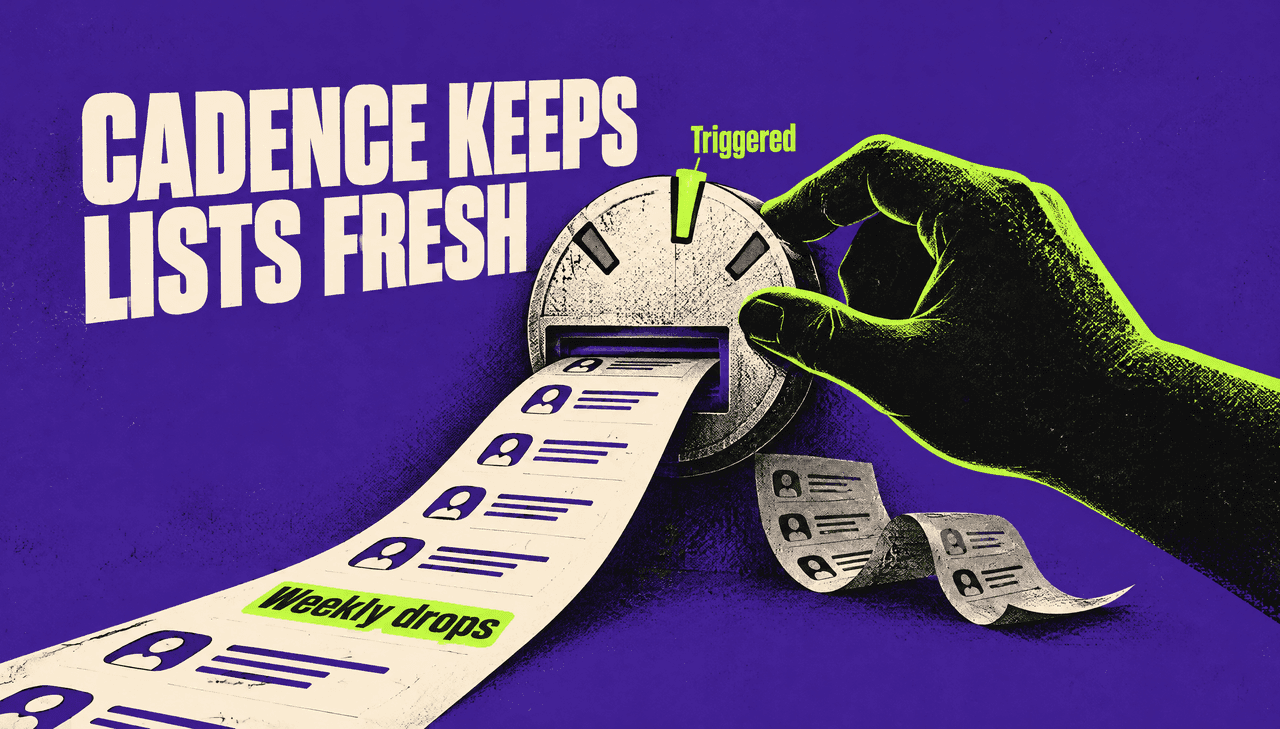
Ask ten agency owners how often they deliver lead lists to clients and eight will say "monthly." Ask why, and the answer is rarely strategic. It is usually "that's what the retainer is," or "that's how the tool bills," or simply "that's how we've always done it." Cadence gets filed under admin — a line item in the scope of work — when it is actually one of the strongest signals you send a client about whether their pipeline is being actively worked.
Cadence is a design decision. It determines how fresh the data is when a rep actually dials, how much of your credit budget gets consumed per client per month, and whether the client renews because they feel momentum or churns because they quietly started exporting leads themselves. This guide breaks down the three operating cadences an agency can run — weekly drops, monthly subscriptions, and campaign-triggered refreshes — and shows how each one maps to client type, ICP volatility, and outbound motion.
Why cadence is a retention lever, not an admin task
Start with the physics of the problem. B2B contact data decays continuously. People change jobs, get promoted, switch domains, abandon inboxes, and move into roles where your client's pitch is no longer relevant. A list delivered on the third of January and never touched again is not an asset — it is a depreciating inventory the client is paying to store.
Salesforce's guidance on B2B lead generation strategies frames lead generation as an ongoing process tied to data quality and timing, not a one-time export. That framing matters for agencies because it reframes what the client is actually buying. They are not buying a file. They are buying a pipeline input that has to stay current for the duration of the engagement.
When cadence is mismatched to the client's reality, churn usually shows up in one of three patterns:
- Stale data erosion. Replies fall from 4% to 1.5% over eight weeks. The client blames list quality. The real cause is that nobody refreshed the segment while the campaign was running.
- Timing mismatch. Leads land two weeks after the campaign launched. The SDR team has already moved to a different offer, so the list sits in a spreadsheet until it is cold.
- Opacity churn. The client does not know what is coming, when, or how much. They start building their own lists on the side, then decide they can do the whole thing cheaper in-house.
Every one of those problems is solved or created by cadence. A weekly client never experiences stale data erosion because the segment is re-run before the shelf life expires. A campaign-triggered client never experiences timing mismatch because delivery is bound to an event. A monthly client with a documented, predictable rhythm has no reason to build lists on the side.
The three operating cadences: weekly, monthly, campaign-triggered
Treat these as a portfolio, not a hierarchy. No cadence is universally better. Most agencies running more than a handful of clients end up with all three in the book at the same time, because a high-velocity SaaS client and a slow-cycle industrial manufacturer cannot be served by the same delivery rhythm.
- Weekly cadence: segmented drops delivered on a fixed day each week, sized to what the SDR team can consume in that cycle, with the previous cycle's contacts suppressed.
- Monthly cadence: a larger batch delivered once per month, typically aligned to campaign planning or reporting cycles, with a defined freshness window.
- Campaign-triggered cadence: event-driven refreshes shipped when a specific condition is met — a launch, a new vertical, a funding signal, a persona shift, or a reactivation push.
The rest of this article maps each model to client type, quantifies the operational cost, and gives you the workflow and reporting structure to run it without rebuilding your process every month.
Cadence comparison table
Use this as the reference sheet when you are scoping a new engagement or renegotiating an existing one. The "retention risk if misapplied" row is the one most agencies skip — and it is the row that predicts whether you keep the account past month six.
| Dimension | Weekly | Monthly | Campaign-triggered |
|---|---|---|---|
| Typical client | Active outbound team, 2+ SDRs, small-to-mid TAM, high sales velocity | Lean team, founder-led sales, long sales cycle, quarterly planning | Product-led or event-driven GTM, multi-motion agency clients, project work |
| ICP volatility tolerance | High — segment can shift week to week and still be useful | Low — assumes the ICP is stable for the full month | Variable — defined by the trigger condition, not a clock |
| Data freshness expectation | Delivered contacts should be under 7 days old at send time | Contacts can be 30 days old if enrichment and dedupe are solid | Fresh at the moment of the trigger; staleness kills the whole premise |
| Agency effort per cycle | High — 4x the build cycles, 4x the QA passes | Low — one build, one QA, one delivery per month | Bursty — quiet weeks, then heavy build sprints |
| Credit and cost profile | Steady, predictable draw; easy to forecast per client | Lumpy but easy to budget against a fixed retainer | Hard to forecast; needs a buffer and a change-order conversation |
| Retention risk if misapplied | Credit burn and coverage exhaustion make the account unprofitable | Highest churn risk — feels passive, invites DIY list building | Risk of ambiguity; client may not understand what they are paying for between triggers |
| Best-fit motion | High-volume cold email and dialing with a short sequence window | Nurture-heavy, content-led, or ABM-lite motions | Launch, expansion, vertical entry, and reactivation campaigns |
| Ops complexity | High — needs automation or an API-driven pipeline to stay sane | Low — manual builds are fine | Medium — needs a trigger definition and an intake form |
Weekly cadence: when it pays off and when it burns credits
Weekly delivery is the highest-performing cadence for one specific client profile: an active outbound team with a dedicated SDR function, a segment small enough to work thoroughly, and a sales velocity fast enough that a lead delivered on Monday gets touched by Tuesday.
The logic is grounded in how prospecting actually works. HubSpot's material on sales prospecting centers on rhythm and consistent pipeline activity — reps who prospect in structured blocks outperform reps who prospect in unpredictable bursts. A weekly drop matches that rhythm. The rep starts a sequence on Monday with a fresh list, works it through the week, and by the following Monday the next drop arrives with the previous cohort already suppressed.
Weekly also solves the freshness problem structurally. If your delivery window is seven days, contacts are near-current at first touch almost by definition. You do not need to argue about data decay because the data has not had time to decay.
Where weekly goes wrong
- Credit burn without coverage. If the total addressable segment is 1,200 contacts and you ship 250 per week, you run out in five weeks. The sixth week delivers recycled or off-ICP records and the client notices immediately.
- Redundant contacts. Without suppression logic against previously delivered records, the rep emails the same VP of Sales three times in a month and the client's domain reputation takes the hit.
- Client fatigue. Some clients cannot consume 250 records a week. They asked for weekly, they got weekly, and now they have a backlog of untouched lists and a growing sense that they are paying for volume they do not use.
- QA shortcuts. Four delivery cycles per month is four QA passes per month. Teams that do not standardize the QA step start skipping it under volume, and error rates climb.
How to run weekly without bleeding
- Size the segment before you promise weekly. Run coverage checks and confirm how many cycles you can sustain before the pool exhausts.
- Build the drop with a lead search that supports the filters your ICP actually needs — industry, headcount band, title seniority, tech stack, geography — so each weekly build is a re-run of a saved segment rather than a manual rebuild.
- Apply suppression against all previously delivered contacts for that client before export.
- Rotate sub-segments weekly (by geography, by sub-industry, by seniority tier) so you are widening coverage rather than repeatedly hitting the same slice.
- Automate the delivery step. Weekly manual exports across ten clients is a full-time job that nobody budgeted for.
For teams running weekly at scale, the lead search with 20+ filters is where the segment gets defined, and saving that segment is what makes the weekly re-run a two-minute task instead of a two-hour one.
Monthly cadence: the default that quietly causes churn
Monthly is the industry default because it is the easiest cadence to sell and the easiest cadence to bill. It maps cleanly to a retainer, it maps cleanly to a reporting cycle, and it requires the least operational discipline. None of those are reasons it is right for the client.
Monthly is genuinely correct in a few situations:
- The client's ICP is stable and slow-moving — regulated industries, established verticals, long enterprise sales cycles.
- The client has no dedicated outbound team and runs campaigns in monthly or quarterly bursts.
- The total segment is small enough that splitting it into weekly drops would exhaust coverage in a few cycles.
- The motion is nurture-heavy, where a lead delivered on day one and worked over six weeks is fine.
Monthly is a problem when it becomes a disguise for disengagement. Watch for these signals:
- The client has not touched the last two deliverables and has no explanation beyond "we're busy."
- Campaigns launch in the middle of the month, so the leads arrive either stale or early.
- The client asks for "everything at once" instead of a scheduled drop — a sign they are planning to take the data in-house.
- Nobody on the client side can state the freshness window of the records they received.
If two or more of those are true, the cadence is not the problem — but changing the cadence is often the fastest fix. Moving a disengaged monthly client to a smaller, more frequent drop re-establishes the habit of working the list and gives you a weekly reason to be in their inbox with something concrete. A recurring delivery workflow that produces a predictable, smaller deliverable is far more defensible than one large monthly drop nobody opens.
Campaign-triggered cadence: event-driven refreshes
Campaign-triggered delivery replaces the calendar with a condition. You ship a refresh when something specific happens, and the trigger is written down in the scope of work so both sides know what they are waiting for.
Common trigger conditions
- Product launch. A new feature or tier opens a new buyer persona. The refresh targets that persona with the new positioning.
- New vertical or geography. The client expands into a market they have never touched. Coverage needs to be built from scratch.
- Account-level signal events. Funding rounds, headcount spikes, executive hires, or tech-stack installs that indicate readiness at a set of target accounts.
- Persona shift. The client learns that the economic buyer is the CFO, not the VP Ops, and the whole list needs re-tiering.
- Reactivation campaign. Closed-lost accounts are re-run after a product change or a defined cooling period.
- Client-side events. A webinar, a conference, or a co-marketing push that needs a matched outbound list within a tight window.
Making the trigger objective rather than reactive
The weakness of campaign-triggered delivery is ambiguity. If the trigger is "when the client asks," you have no forecasting ability and no defensible scope. Borrow the discipline of lead scoring to formalize it. LinkedIn Sales Solutions' overview of lead scoring is a useful reference here: fit signals plus activity signals, weighted, with a threshold that decides who enters the campaign.
Applied to cadence, that becomes a documented trigger definition like this:
- Fit condition met — the client has a new SKU, a new market, or a new persona that does not exist in the current delivered segment.
- Volume condition met — the projected net-new segment exceeds an agreed minimum (for example, 300 net-new ICP contacts after suppression). Below that threshold, the refresh is rolled into the next scheduled cycle instead.
- Timing condition met — the client has given at least 10 business days' notice before the campaign start date, so QA and enrichment are not rushed.
When all three are met, the refresh ships. When they are not, it waits. That single rule eliminates most of the scope creep that makes campaign-triggered arrangements unprofitable.
The programmatic version
Campaign-triggered cadence is the model most likely to be automated, because the trigger is already a logical condition. Agencies running this at volume wire the intake into a lead generation API so that a satisfied trigger fires a segmented list build, enrichment, dedupe, and export without a human reassembling filters each time. The human work shifts to trigger review and QA rather than list construction.
Cadence selection framework
Run this decision sequence before you write the scope of work. It takes about fifteen minutes and prevents twelve months of friction.
- How volatile is the ICP? If target titles, industries, or company stages change more than once a quarter, weekly is a better fit. If they are stable for six months at a time, monthly works.
- What is the outbound motion? High-volume cold email and dialing with a short sequence window demands weekly. Nurture, content-led, and ABM-lite motions tolerate monthly. Launch and expansion motions need triggers.
- How mature is the client's ICP definition? This is the upstream input that determines whether any cadence will work. If definitions are still being validated, start with smaller, more frequent drops so each cycle produces a faster feedback loop instead of a month of waiting for a verdict.
- How large is the addressable segment? Preview the count before committing. A weekly cadence on a 900-contact segment is a five-week plan, not a twelve-month one.
- What is the credit ceiling? Weekly delivery draws credits roughly four times faster than monthly at the same per-drop size. If the retainer was priced for monthly volume, weekly will destroy your margin unless the tier is renegotiated.
- Who consumes the list? If there are two active SDRs, weekly drops sized to 100–125 records each are realistic. If there is one founder doing outbound between other work, weekly drops of that size become a backlog.
Map the answers:
- Volatile ICP + active outbound team + large segment + adequate credit ceiling → weekly
- Stable ICP + lean team + long cycle → monthly
- Launch-driven or expansion-driven motion + unpredictable demand → campaign-triggered, with a light monthly baseline underneath it so the client always has something in motion
Operational workflow for each cadence
All three cadences run on the same building blocks. What changes is how often each block fires and how much of it is automated.
The shared pipeline
- ICP refresh. Confirm the segment definition against the client's current positioning. Log any changes, even small ones.
- Segment build. Apply filters — industry, headcount, revenue band, title seniority, department, geography, and where available, technology or hiring signals.
- Count preview. Check the net-new volume before spending credits. Run the count against the suppression list, not the raw universe. Previewing before exporting is what keeps a weekly cadence financially survivable.
- Filter refinement. If the preview returns more than the drop size, tighten. If it returns less than the minimum viable drop, widen or defer.
- Enrichment. Resolve verified emails for the selected contacts. Add phone numbers only where the motion actually supports calling — this is often where budget leaks.
- Dedupe. Against previously delivered contacts for that client, against the client's CRM, and against each other.
- QA pass. Spot-check a sample for title accuracy, company fit, and domain validity. Check formatting against the client's import requirements.
- Delivery. CSV, CRM push, or a shared sheet with a defined naming convention that includes client name, date, and segment ID.
- Client confirmation. A short message stating what was delivered, the freshness window, and the next drop date.
How the pipeline flexes by cadence
| Step | Weekly delta | Monthly delta | Campaign-triggered delta |
|---|---|---|---|
| ICP refresh | Light — review changes only | Full re-validation | Trigger-specific rebuild |
| Segment build | Saved segment, re-run | Saved segment, re-run with wider size | New segment built per trigger |
| Count preview | Every cycle, mandatory | Every cycle | Before quoting the refresh |
| Enrichment | Email only, tight scope | Email + phone where relevant | Depends on campaign channel |
| QA | Sampled, standardized checklist | Full manual review | Full review — trigger refreshes are high-visibility |
| Delivery | Automated push to shared folder or CRM | Manual export with summary note | Coordinated with client campaign calendar |
Two operational notes. First, the count preview step is non-negotiable in any recurring model, because it is the only thing standing between a healthy credit position and an overrun. Second, QA should be the same checklist regardless of cadence — the checklist changes in depth, not in content.
Client reporting and retention checklist
The delivery report is a retention artifact. It is the document the client reads when someone in finance asks whether the agency is worth the retainer. Build it once, use it every cycle, and anchor it to the client's funnel stages so the numbers map to language they already use internally.
Every delivery report should carry these fields:
- Delivery date — the actual date the file or CRM push landed, not the planned date.
- Records delivered — net of suppression and dedupe.
- Freshness window — the date range during which these contacts were last verified.
- Segment definition changes — anything adjusted since the last delivery, and why.
- Coverage consumed and remaining — how much of the addressable segment has now been delivered.
- Response metrics from the prior drop — opens, replies, meetings booked, and how they compare to the trailing average.
- Next refresh date — always present, even for campaign-triggered accounts, where it should state the pending trigger condition.
- Renewal signal notes — a one-line internal note on client engagement: who responded, whether the last campaign launched, whether feedback came back.
Two things this report accomplishes. It gives the client a documented reason to open a conversation with you every cycle, which is how you surface problems before renewal. And it converts a delivery into a pipeline narrative — contacts delivered, contacts worked, meetings booked — instead of a file transfer the client could theoretically do alone.
Mixing cadences across a client book
Real agencies run a mixed book. Here is how to keep it from becoming an operational mess.
- Tier clients by cadence, not by revenue. Your weekly clients are your highest-touch accounts. Put your most reliable operator on them.
- Forecast credits by client, monthly. Weekly clients consume predictably but fast. Campaign-triggered clients consume unpredictably. Keep a buffer for the second group so a burst does not stall a weekly client's delivery.
- Renegotiate when the cadence changes. Moving a client from monthly to weekly roughly quadruples credit consumption. That is a new tier, not a favor.
- Look for the upgrade path. A monthly client who starts asking about campaign timing is a candidate for campaign-triggered delivery with a monthly baseline. A campaign-triggered client with a growing outbound team is a candidate for weekly. Each of these moves increases the value delivered and the retainer alongside it.
- Review cadence fit quarterly. ICPs shift, sales teams grow and shrink, budgets move. A cadence chosen in month one is not automatically right in month nine.
When it is time to move a client up a tier, frame it around delivery outcomes rather than features — more frequent refreshes mean fresher contacts at first touch, which is the variable most correlated with reply rate. If you need concrete numbers to support that conversation, benchmarking your delivery metrics per cadence gives you the evidence to make the upgrade a data conversation instead of a sales pitch.
Closing: design the cadence before you sign the retainer
Cadence is not a setting. It is the operating rhythm of the account, and it determines whether the client experiences your agency as an ongoing function or as a vendor who sends files. Weekly wins when the client has an active outbound engine and the segment can support the volume. Monthly works when the ICP is stable and the motion is deliberate — but it becomes a churn engine when it is used as a default. Campaign-triggered delivery wins when the client's demand is genuinely event-driven, provided the trigger conditions are written down and objective.
The practical sequence is simple. Assess ICP volatility, sales motion, segment size, and credit budget. Pick the cadence that fits. Document the trigger or the schedule in the scope of work. Run the same pipeline with the right depth of QA. Report on it every cycle with the same fields. Then, when the client's motion changes, change the cadence with it.
If you are still running every client through the same monthly drop because that is what the retainer assumes, start by rebuilding one account on a weekly or triggered rhythm and measuring the difference in engagement. You can build the segments for either model in the same place — start with the agency lead list builder to structure client-specific segments and delivery-ready exports, and wire recurring or trigger-driven builds into the lead generation API when manual cycles stop scaling.