Dievio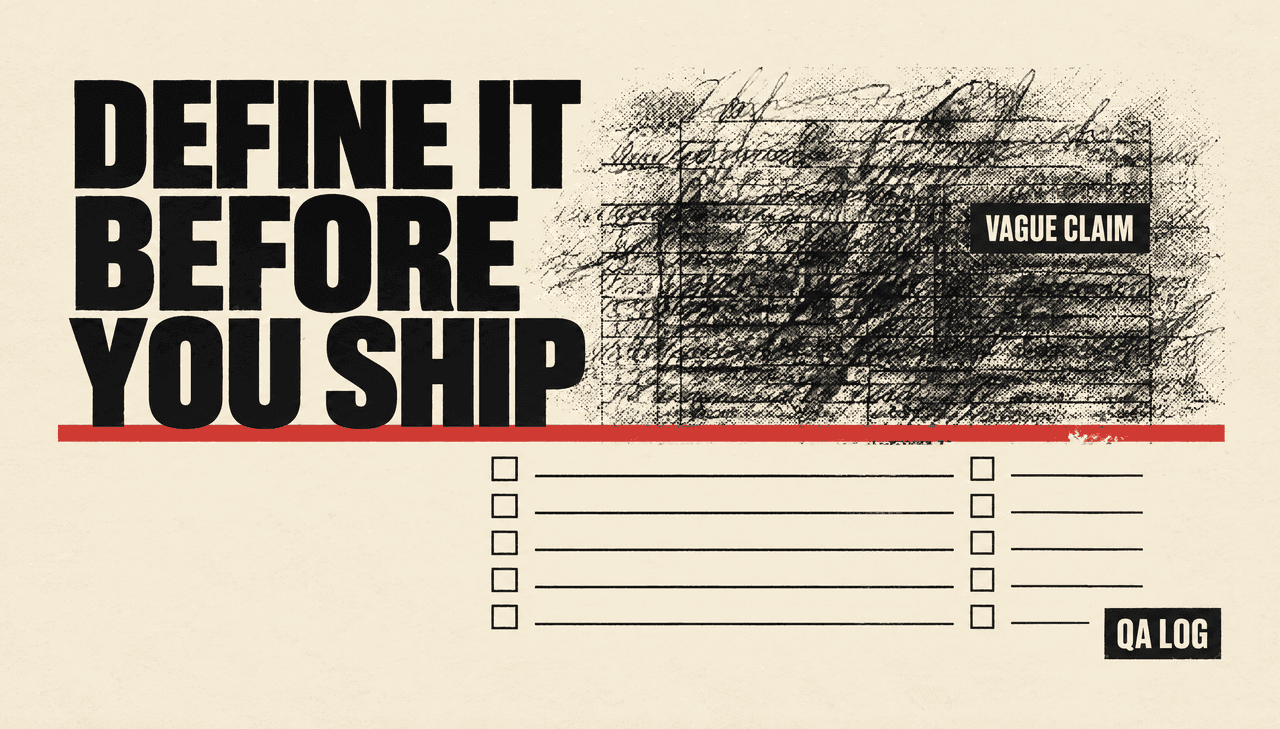
Why data quality is the agency risk nobody prices in
Every agency that sells lead lists has a version of the same story. A client approves a 10,000-row drop. The list ships. Three weeks later the campaign underperforms, and the account lead is on a call trying to explain why 400 emails bounced, why 60% of the titles were wrong, and why the client's SDR team is now manually re-qualifying rows the agency was paid to qualify in the first place.
The uncomfortable part is that in most of those disputes, the agency did not actually do anything wrong by its own standard. It just never wrote the standard down. "Clean, verified, accurate data" is a sales phrase, not an operational definition. It cannot be measured, it cannot be reported, and it cannot be defended. When a client challenges it, the agency is arguing about vibes.
Prospecting outcomes depend on list quality more than most agencies admit. HubSpot's guidance on sales prospecting treats research and qualification as the front half of the sales process, not a data-entry step before it. If the list is wrong, everything downstream — sequencing, personalization, scoring, forecasting — is built on a bad foundation. That is why quality has to be defined before the deliverable leaves the door, not after the client complains.
This is the operational playbook for turning "accurate data" into a contractually defined, measurable, and reportable quality standard. It covers the five dimensions worth guaranteeing, the numeric thresholds you can defend, the QA workflow that enforces them, the reporting cadence that protects renewals, and the playbook for the moment a client pushes back.
What "data quality" actually means in an agency contract
Marketing language and operational language are not the same thing. Before you can guarantee anything, you have to translate the sales claim into a definition a QA analyst can test.
- "Clean" — meaningless on its own. Does it mean no duplicates, no malformed fields, no role accounts, or all three?
- "Verified" — verified when, by what method, and against what failure rate? A row verified 14 months ago is not the same asset as a row verified last week.
- "Accurate" — accurate on which field? Email, title, company, headcount, and geography all decay at different rates and have different tolerances.
- "Targeted" — targeted against whose ICP definition, and who signed off on it?
The fix is to stop selling a single adjective and start selling a small set of named dimensions, each with its own metric, threshold, and remediation policy. Five dimensions cover almost every dispute an agency will ever have: accuracy, deliverability, completeness, freshness, and coverage. The rest of this article maps the work to each one.
The five core quality dimensions (and the metrics behind them)
Each dimension below is a guarantee you can put in writing. The "how to calculate" column matters more than the target — a threshold without a measurement method is just another adjective.
| Dimension | What it measures | How to calculate | Defensible target | Common failure mode |
|---|---|---|---|---|
| Accuracy | Whether the field values match reality at delivery time | Random sample of 200–500 rows, manually or programmatically re-checked against source; error rate = mismatches ÷ sample size | 95%+ on email, 90%+ on title, 92%+ on company name | Guaranteeing one blended "accuracy" number that hides a weak title match rate |
| Deliverability | Whether the email actually reaches an inbox without bouncing | Post-send bounce rate from the sending platform, measured over the first 72 hours | Under 2% hard bounce, under 3% total bounce | Confusing a valid syntax with a deliverable mailbox; ignoring catch-all domains |
| Completeness | Whether every row carries the fields the client's workflow needs | Rows with all required fields populated ÷ total rows | 98%+ on required fields, 85%+ on optional enrichment | Shipping rows with missing first names because the client's sequence uses them |
| Freshness | How recently the record was sourced or re-validated | Age of the last validation timestamp, reported as a distribution not an average | 90%+ of rows validated within 90 days; 100% within 180 days | Reporting a mean age that hides a long tail of two-year-old records |
| Coverage | Whether the list represents the full addressable segment, not just the easy slice | Delivered rows ÷ estimated segment size from a preview count | 70%+ of the addressable segment, or an explicit explanation of the gap | Quietly returning 400 rows for a segment the client believes is 4,000 companies |
Salesforce frames B2B lead generation as a funnel-wide discipline rather than a list-export task, which is the right mental model here: their B2B lead generation guidance treats data quality as a precondition for every stage that follows. If you guarantee accuracy but not coverage, the client gets a clean list of the wrong-sized universe.
Setting SLAs: numeric thresholds agencies can actually defend
The temptation is to promise 99% on everything. Do not. A threshold you miss once is a credit request; a threshold you miss three times is a lost retainer. Set numbers you can hit on a bad week, then beat them on a good one.
Practical ranges that hold up across most B2B segments:
- Email accuracy: 95%+ verified deliverable at delivery. Push to 97%+ only if you re-validate immediately before export.
- Hard bounce rate: under 2% on the first send. This is the number clients actually feel, because it hits their sending domain reputation.
- Title match: 90%+ against the agreed seniority and function filters. Title decay is faster than email decay, so this is where most disputes originate.
- Company match: 92%+ on firmographic filters — industry, headcount band, revenue band, geography.
- Duplicate rate: under 1% within a single delivery, and under 3% against the client's existing CRM records if you have suppression access.
- Freshness window: 30 days for high-churn segments like early-stage startups, 60 days for mid-market, 90 days for enterprise and regulated industries.
- Coverage: 70%+ of the addressable segment, with the shortfall explained in writing rather than silently absorbed.
Thresholds should flex by client, not by mood. A client targeting Series A founders in a niche vertical has a smaller universe and a higher tolerance for coverage gaps. A client targeting operations managers at 500+ employee logistics companies has a large universe and no tolerance for title drift. Write the threshold to the segment, then hold it.
One operational note that saves arguments later: sample before you commit. Previewing counts and pulling a small validation sample lets you set a threshold you have already tested rather than one you hope holds. Dievio's lead preview tool exists precisely for this — you size the segment and sanity-check the field quality before credits are spent or a number is promised in a contract.
The pre-delivery QA workflow
Quality guarantees fail at the handoff, not at the search. Build the workflow so nothing ships without passing through five gates.
- Filter build. Translate the client's ICP into explicit filters — function, seniority, headcount band, industry, geography, technology, funding stage. Every filter must trace back to a line in the signed ICP document. Build these in Dievio's lead search with its 20+ filters so the segment definition is reproducible next month, not reconstructed from memory.
- Preview and size. Pull the count before pulling the rows. If the segment returns 380 rows when the client expects 3,800, that is a conversation to have now, not at delivery.
- Export and automated re-validation. Run the export through a programmatic re-validation pass — syntax check, MX record check, catch-all flagging, suppression list matching, duplicate detection. This is the step that most agencies do manually and therefore skip when volume spikes. The lead generation API is built for exactly this: recurring list generation with validation baked into the pipeline rather than bolted on afterward.
- Human spot check. Pull a random sample of 50–100 rows and verify by hand against LinkedIn or the company site. Automated validation catches syntax and deliverability; it does not catch a "VP of Sales" who was promoted to CRO last month or a company that was acquired.
- Sign-off and logging. Record the sample size, the error rate per dimension, the validation timestamp, and the name of the person who approved the delivery. This log is the artifact that wins the argument three weeks later.
Pre-delivery QA checklist
Fourteen items, mapped to the five dimensions. Nothing ships until every box is ticked or explicitly waived in writing.
- Function match — every row's department aligns with the ICP definition
- Seniority match — titles fall inside the agreed band, not one level above or below
- Company size match — headcount and revenue bands verified against the filter
- Geography match — country, region, and where relevant, metro area
- Industry match — no rows from adjacent verticals that slipped through keyword matching
- Email syntax valid — no malformed local parts or domains
- MX record present — the domain can actually receive mail
- Catch-all domains flagged — separated from verified mailboxes, not blended into the count
- Role accounts excluded — info@, sales@, admin@ removed unless the client asked for them
- Suppression list applied — existing clients, competitors, opt-outs, and the client's current pipeline
- Duplicate rate measured — within the file and against the client's CRM if accessible
- Freshness timestamp attached — every row carries a last-validated date
- Source mix documented — which records came from which source, so a bad batch can be traced
- Sample error rate recorded — the actual measured accuracy from the spot check, not an estimate
This checklist is the enforcement layer for the guarantees. If you want the deeper version — the one that covers edge cases, exception handling, and per-dimension remediation — that is worth its own document, and the framework here is designed to feed into it.
Email deliverability as a separate, named guarantee
Agencies routinely conflate email accuracy with deliverability, and it costs them. They are different guarantees with different owners.
Accuracy is a data property: the address is correct and belongs to the person you think it belongs to. Deliverability is an infrastructure and reputation property: the message reaches the inbox without bouncing or landing in spam. You can deliver a 99% accurate list and still see an 8% bounce rate if the client's sending domain is cold, their volume ramped too fast, or their authentication is misconfigured.
Separating them protects the agency. Write the deliverability guarantee as a shared responsibility with explicit boundaries:
- Agency owns: hard bounce rate attributable to invalid addresses, role-account exclusions, catch-all flagging, and suppression hygiene.
- Client owns: domain warm-up, SPF/DKIM/DMARC configuration, sending volume ramp, and content that does not trigger spam filters.
- Shared: inbox placement. No list vendor can guarantee inbox placement, because it depends on the sender's reputation and the recipient's filters. Say this out loud in the contract.
Catch-all domains deserve their own line item. A catch-all domain accepts mail for any address, so validation cannot confirm the mailbox exists. The honest approach is to flag them, report them as a separate count, and let the client decide whether to include them. Blending catch-alls into a "verified" count is the fastest way to lose a deliverability argument.
Quality reporting cadence: what to show clients and when
Guarantees are only as strong as the reporting that proves them. A client who sees a quality report every month does not open a dispute in month four — they open a renewal conversation.
| Cadence | What to report | Why it matters |
|---|---|---|
| Per delivery | Row count, dimension-by-dimension pass rates, sample error rate, freshness distribution, exception log | Creates the paper trail that defends the delivery if challenged later |
| Monthly | Rolling accuracy and bounce trends, SLA compliance status, corrective actions taken, coverage vs. addressable segment | Shows the trend line, not a single data point; surfaces drift before it becomes a complaint |
| Quarterly | Quality scorecard vs. SLA, cost-per-qualified-contact, downstream conversion by list cohort | Connects list quality to pipeline outcomes and justifies the retainer |
The monthly report is the one that protects renewals. Keep it to one page: five dimensions, the target, the actual, the delta, and any corrective action. If a dimension missed, say so before the client finds it. Agencies that self-report misses keep clients; agencies that get caught do not.
Tie the report back to prospecting outcomes rather than data vanity metrics. HubSpot's prospecting framework emphasizes qualification as an ongoing process, not a one-time gate — which is exactly the argument for a recurring quality report rather than a one-off delivery receipt. The client is not buying rows; they are buying a qualified pipeline input.
Defending accuracy when a client pushes back
It will happen. A campaign underperforms, the client blames the list, and the account lead has 48 hours to respond. Run the playbook in order.
- Pull the QA log first. Before responding, retrieve the delivery's sample size, measured error rate, validation timestamp, and sign-off. Do not argue from memory.
- Restate the SLA thresholds. Show the contract language next to the measured result. If you hit 96% email accuracy against a 95% guarantee, the list met the standard and the conversation needs to move.
- Separate data issues from messaging issues. Pull the bounce report. If hard bounces are under 2%, the list performed. Low reply rates on a technically clean list are a messaging, offer, or targeting problem — a different conversation with a different fix.
- Check the downstream scoring. The same list can look excellent or terrible depending on how the client scores and routes it. LinkedIn's overview of lead scoring is useful here: if the client's scoring model weights a field you did not guarantee — say, technology stack or intent signal — the apparent quality problem is a scoring-model mismatch, not a data defect.
- Offer a concrete remedy. Re-pull the failing segment at no credit cost, issue a proportional credit, or add a validation pass to the next delivery. Pick one and commit to it in writing.
- Log the learning. Every dispute reveals a gap between what the client assumed and what the SLA said. Update the ICP document or the threshold, and note it in the next quality report.
The agencies that handle this well are not the ones with perfect data. They are the ones with a log, a threshold, and a remedy ready before the call.
How Dievio supports the guarantee end to end
Guarantees are only as good as the workflow underneath them. Each dimension maps to a specific capability, so the QA process is built into the tooling rather than reconstructed by hand every month.
| Guarantee | How it is enforced |
|---|---|
| Accuracy | Filter-driven search plus a pre-export validation pass; sample verification before sign-off |
| Deliverability | Syntax and MX validation, catch-all flagging, role-account exclusion, suppression matching |
| Completeness | Required-field enforcement at export; enrichment for missing names, titles, and firmographics |
| Freshness | Validation timestamps on every row; scheduled re-validation for recurring deliveries |
| Coverage | Preview counts before export so segment size is known and gaps are explained, not discovered |
The practical stack for an agency running this at scale looks like three layers. First, lead search with granular filters to build the segment reproducibly. Second, preview counts to size it and sample it before committing credits. Third, the lead generation API to automate re-validation, suppression matching, and the metrics that feed the monthly quality report — which is the difference between a guarantee you can prove and a guarantee you can only claim.
For agencies that want the workflow already assembled — segmented delivery, repeatable QA, and client-ready reporting — the agency lead list program is built around exactly this operating model.
Putting it together: a one-page quality guarantee template
Copy this structure into your next client contract or SOW. It fits on one page and it ends most disputes before they start.
- Five-dimension matrix. Accuracy, deliverability, completeness, freshness, coverage — each with a metric, a threshold, and a measurement method.
- QA workflow. Filter build, preview, automated re-validation, human spot check, sign-off and logging.
- Report cadence. Per-delivery exception log, monthly one-page scorecard, quarterly outcome review.
- Remediation policy. What happens when a threshold is missed — re-pull, credit, or added validation pass — stated in advance.
- Shared-responsibility clause. Explicit boundaries on deliverability: what the agency owns, what the client owns, and what neither can guarantee.
The upstream dependency is the ICP document. A quality guarantee is only meaningful if the target definition it enforces is precise — which is why the ICP validation work comes first and the QA checklist enforces it second. Get the definition right, write the thresholds down, log every delivery, and report on a schedule. That is the entire difference between an agency that sells "accurate data" and one that can stand behind it.
If you are ready to ship lists with the guarantee already built into the workflow, start with the agency lead list program and size your first segment before you promise a number.
Build Your First Outbound List to validate the segment before you commit to full outreach.