Dievio
Outbound A/B Testing Framework: What to Test and When for B2B Campaigns
Most B2B outbound teams operate on a foundation of guesswork. You send an email, you get a reply, you tweak the subject line, and you hope for the best. This approach is not just inefficient; it is dangerous. When you test randomly, you are essentially throwing darts at a board in the dark. You might hit the bullseye, but you won't know why, and you certainly won't be able to replicate the success. In the high-stakes world of B2B sales, where every hour of prospecting time is an investment, wasting resources on invalid experiments is a direct hit to your bottom line.
This is why a structured outbound A/B testing framework is non-negotiable for any team serious about scaling. It is not about trying every possible variable you can think of. It is about prioritizing the right variables, running statistically valid experiments, and building a compounding testing process. When you move from random tweaking to a systematic methodology, you stop guessing and start engineering better results. This guide provides the practical, systematic approach you need to decide what to test, when to test it, and how to interpret results without wasting campaign time.
A/B Testing Fundamentals for B2B Outbound
Before you can build a framework, you must understand what constitutes a valid test. Marketing A/B testing often focuses on click-through rates and broad audience engagement. In B2B outbound, the metrics are different, and the stakes are higher. A single email might be read by one person, but that one person represents a potential pipeline value of thousands of dollars. Therefore, your testing methodology must be rigorous.
A valid A/B test in an outbound context requires four core elements: a hypothesis, a control, a variant, and a metric. Your hypothesis is the statement you are testing. For example, "Adding a specific company metric to the subject line increases reply rates." The control is your current best-performing email or the baseline you are comparing against. The variant is the specific change you are introducing. Finally, the metric is the data point you are measuring, such as reply rate or meeting booked.
The difference between a marketer and an outbound operator is the definition of success. In marketing, success is often defined by brand awareness or clicks. In outbound, success is defined by revenue-impacting actions. If you are testing a subject line, the metric should be reply rate. If you are testing a call-to-action (CTA), the metric should be meeting booked. You must align your test variable with the metric that matters most to your sales cycle. Without this alignment, you may optimize for vanity metrics that do not translate to pipeline.
Furthermore, you must isolate the variable. If you change the subject line and the body copy simultaneously, you have no way of knowing which change drove the result. This is the most common pitfall in early-stage testing. To run a valid experiment, you must change only one thing at a time. This allows you to attribute the outcome directly to the variable you are testing, ensuring that your data is actionable.
What to Test: Variable Categories
Not all variables are created equal. Some changes have a massive impact on performance, while others have negligible effects. Testing low-impact variables wastes your sample size and campaign budget. To prioritize your testing efforts, we categorize variables by their typical impact on campaign performance. This ranking helps you decide where to focus your energy first.
Below is a breakdown of testable variables by category, ranked by typical impact. This hierarchy is based on industry standards and operator experience.
| Category | Variable Examples | Typical Impact | Testing Priority |
|---|---|---|---|
| Segment (ICP) | Industry, Company Size, Job Title, Tech Stack | High | Phase 1 |
| Message (Body) | Opening Hook, Value Prop, Personalization | High | Phase 2 |
| Message (Subject) | Length, Tone, Personalization, Curiosity | Medium | Phase 2 |
| Timing | Send Day, Send Hour, Follow-up Delay | Medium | Phase 2 |
| Sender | Name, Signature, Sending Domain | Low | Phase 3 |
| CTA | Link Placement, Call to Action Text | Low | Phase 3 |
Notice that Segment and Message are at the top. This is because a mismatched ICP will kill your reply rate regardless of how perfect your copy is. If you are sending to a job title that does not own the budget, no amount of personalization will save the campaign. Therefore, your first tests should validate your list quality before you obsess over the subject line.
Once your segment is validated, you move to the message. The opening hook is critical because it determines open rates and initial engagement. If the prospect does not care about the opening, they will not read the rest. After the message, you look at timing and sender details. These are often overlooked but can provide incremental gains once the core message is optimized.
When you are ready to scale, you can test lower-impact variables like sender names or specific CTA phrasing. However, do not let these distract you from the foundational work. A common mistake is to test the sender name on a campaign that is failing because the ICP is wrong. Always follow the hierarchy of impact.
For additional context, see HubSpot on sales prospecting.
The Three-Phase Testing Framework
To manage this complexity, we utilize a three-phase testing framework. This cadence ensures that you are not testing in a vacuum. Each phase has a specific goal, a different sample size requirement, and a distinct set of variables. This structure prevents you from running optimization tests on a broken foundation.
Phase 1: Validation
The goal of Phase 1 is to validate segment quality and establish a baseline reply rate. Before you spend money on expensive copywriting, you need to know if your list is viable. In this phase, you are testing the ICP segmentation. You might split your list by industry or company size to see which segment responds better.
Sample size requirements are higher here because you are looking for significant differences in baseline performance. You need enough data to confirm that one segment is genuinely better than another. If you find that Segment A has a 2% reply rate and Segment B has a 0.5% reply rate, you know where to focus your resources. This phase is about risk mitigation.
Phase 2: Optimization
Once you have identified the winning segment, you move to Phase 2. Here, the goal is to optimize the message and timing. You test the subject line, the opening hook, and the value proposition. You also test send times to see when your prospects are most active.
This is where most teams get stuck. They assume their first draft is the final draft. In reality, the first draft is just the baseline. You need to run multiple variants to find the winner. This phase requires a moderate sample size, as you are looking for marginal improvements rather than fundamental shifts in list quality.
Phase 3: Expansion
Phase 3 is about scaling winners and testing new channels. Once you have a message that converts, you test how it performs across different sending domains or with different sender names. You might also test new channels, such as LinkedIn InMail or phone calls, using the same messaging framework.
Sample size requirements are lower here because you are testing variations of a known winner. The risk is lower, and the goal is to maximize the efficiency of your outreach. This phase is where you compound your results, taking the learnings from Phase 1 and 2 and applying them to a broader audience.
When to Test: Timing and Triggers
Testing is not a one-time event. It is a continuous process that evolves as your campaign matures. You need to know when to trigger a test based on the campaign lifecycle. Running tests at the wrong time can lead to invalid conclusions or wasted resources.
When launching a new campaign, you should immediately enter Phase 1. Do not wait for the campaign to run for a month. Send a small batch of your best prospects to validate the segment. If the reply rate is below your target threshold, stop and refine the list. Do not proceed to optimization until the foundation is solid.
For established campaigns, you should run Phase 2 tests on a quarterly basis. If your reply rate has plateaued, it is time to test new hooks or value propositions. If your conversion rate has dropped, it might be time to test a new CTA or follow-up delay. Regular testing keeps your campaign fresh and prevents stagnation.
When refreshing your list, you must re-validate. Data decays over time. A prospect who was active last year might not be active now. If you are adding new leads to your database, treat them as a new campaign. Run a validation test to ensure the new data quality is comparable to your historical data.
For additional context, see Salesforce guide to B2B lead generation.
Finally, team maturity triggers testing. If your team has been running the same campaign for six months without changes, it is time to test. Stagnation is the enemy of growth. Even if your campaign is performing well, you should test to see if you can improve it further. The goal is continuous improvement, not just maintaining the status quo.
Sample Size Requirements
One of the most critical aspects of the outbound A/B testing framework is understanding sample size. Many teams draw conclusions from too little data, leading to false positives. A false positive occurs when you believe a variant is better than the control, but the difference is actually just random noise. This is dangerous because you might scale a losing variant and waste budget.
To avoid this, you must calculate the minimum sample size required for statistical significance. This depends on your baseline metric. If your baseline reply rate is 1%, you need a much larger sample size to detect a 0.5% increase than if your baseline is 10%.
Below is a table showing minimum sample sizes for different metrics. These numbers are estimates based on standard statistical confidence levels (95% confidence, 5% significance).
| Metric | Baseline Rate | Target Lift | Minimum Sends Required |
|---|---|---|---|
| Reply Rate | 1% | +0.5% | 5,000 |
| Reply Rate | 5% | +1% | 1,000 |
| Meeting Booked | 0.5% | +0.25% | 10,000 |
| Meeting Booked | 2% | +0.5% | 2,500 |
Notice the difference in sample size for Meeting Booked vs. Reply Rate. Meetings are harder to book, so you need more volume to see a significant difference. If you are testing a CTA that changes meeting booking rates, you need to ensure you send enough emails to get a statistically significant result.
A simple formula for calculating required sends is: N = (Z^2 * P * (1-P)) / E^2. Where N is the sample size, Z is the Z-score (1.96 for 95% confidence), P is the proportion (baseline rate), and E is the margin of error. While this formula is complex, the principle is simple: higher baseline rates require smaller samples, and smaller lifts require larger samples.
Always wait until you hit the sample threshold before analyzing results. If you stop a test early because you have 100 replies, you might be tempted to declare a winner. Do not do this. Wait for the full sample size to ensure the data is reliable. Patience is a virtue in outbound testing.
The Outbound Testing Playbook
Now that you understand the framework, you need a workflow to execute it. This playbook outlines the step-by-step process for running a test from hypothesis to documentation. Following this workflow ensures consistency and reduces the chance of human error.
- Define Hypothesis: Write down exactly what you expect to happen. "Changing the subject line from 'Hi' to '[First Name] I noticed...' will increase reply rates by 10%."
- Set Control and Variant: Identify the current email as the control and create the new version as the variant. Ensure only one variable changes.
- Build Split Segments: Use your lead data tool to split your list into two equal groups. Ensure the groups are randomized and of equal size.
- Launch with Identical Timing: Send both segments at the exact same time. Do not stagger the sends, as time of day can skew results.
- Wait for Sample Threshold: Do not analyze results until you have reached the minimum sample size calculated in the previous section.
- Analyze with Statistical Significance: Compare the results. If the difference is statistically significant, the variant is the winner.
- Document and Apply Winners: Record the result in your CRM. Apply the winning variant to the full campaign. If the test failed, document why and move to the next hypothesis.
This workflow is repeatable. You can apply it to every test you run. By standardizing the process, you remove the guesswork and make it easier to train new team members. Consistency is key to building a reliable testing culture.
Testing Infrastructure Checklist
Before you run your first test, you need to ensure your infrastructure is ready. Many teams fail not because of bad copy, but because of poor tracking. If you cannot attribute a reply to a specific variant, the test is useless. You need to set up your tools to capture the data correctly.
For additional context, see LinkedIn Sales Solutions on the sales process.
- Tracking UTM or Reply Tags: Ensure every email variant has a unique tracking parameter. This allows you to see which email generated the reply in your email service provider.
- Separate Sending Domains: If testing sender names, use separate sending accounts or domains to avoid deliverability issues. Mixing test groups can hurt your sender reputation.
- CRM Fields for Attribution: Set up custom fields in your CRM to capture the test variant ID. This ensures that when a deal closes, you know which test variant contributed to the win.
- Minimum Data Hygiene: Ensure your lead data is clean before testing. If one segment has outdated emails and the other has fresh data, the test is invalid.
- Consistent Timing: Verify that your sending schedule is identical for both segments. Any delay in one group can skew the results.
Building this infrastructure takes time, but it is essential. Without it, you are flying blind. Take the time to set up these tracking mechanisms before you launch your first campaign. It will save you hours of troubleshooting later.
Common Testing Mistakes
Even experienced operators make mistakes. Being aware of these common pitfalls will help you avoid them. These mistakes often silently kill campaign performance without the operator realizing why.
- Testing Too Many Variables: Changing the subject line, the body, the sender, and the timing all at once. You will not know what caused the result.
- Drawing Conclusions Before Sample Threshold: Stopping a test too early. You might think you found a winner, but it was just random chance.
- Not Isolating the Variable: Changing the subject line and the personalization simultaneously. You cannot attribute the lift to the subject line.
- Ignoring List Quality Differences: Splitting the list randomly without checking for data quality. If one segment has more invalid emails, the reply rate will be lower regardless of the message.
- No Documentation of Winners: Running a test but not recording the result. You might forget what worked, and you lose the learning opportunity.
Avoiding these mistakes requires discipline. It requires sticking to the framework and the workflow. When you are tempted to skip a step, pause and ask yourself if it compromises the validity of the data. If the answer is yes, do not do it.
Conclusion and Next Steps
Building an outbound A/B testing framework is the difference between a team that guesses and a team that engineers growth. By prioritizing the right variables, running valid experiments, and following a structured cadence, you can compound your results over time. You are not just sending emails; you are running a scientific process to find the highest converting message for your ICP.
Start small. Do not try to test everything at once. Begin with Phase 1 validation to ensure your list quality is solid. Once you have a baseline, move to Phase 2 optimization to refine your message. As you gain confidence, expand to Phase 3 to scale your winners. Remember, the goal is not to find the perfect email on the first try. The goal is to find the best email faster than your competitors.
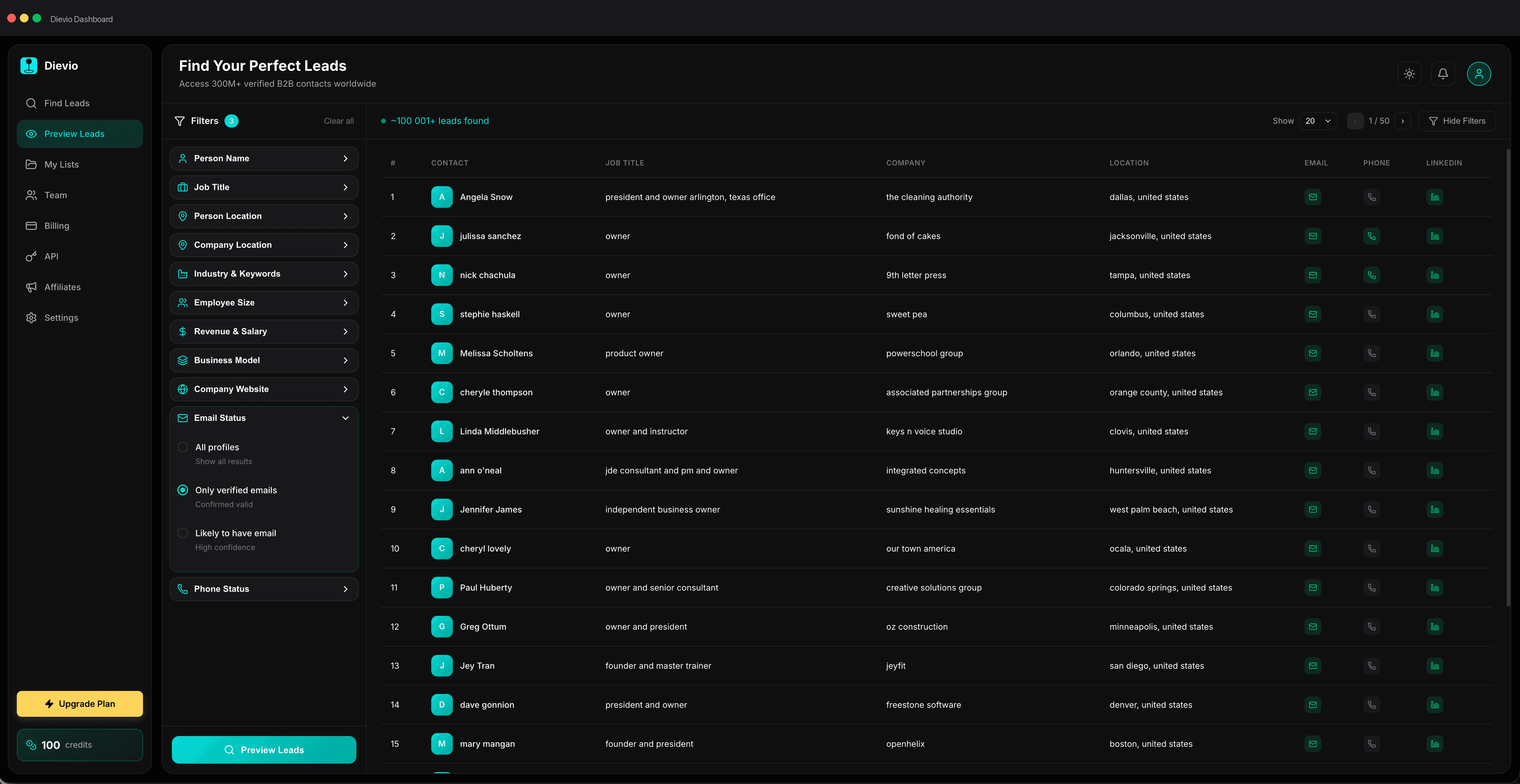
As you implement this framework, keep your data hygiene high. Ensure your lead lists are fresh and accurate. If you are struggling with list quality, consider using a tool that helps you build targeted segments with precision. For example, you can use advanced filtering to create test cohorts that are truly comparable. This ensures that your testing results are driven by your message, not by the quality of your data.
If you are ready to start building your test segments with precision, you need the right tools. You can build test segments with 20+ filters to ensure your cohorts are clean and comparable. This allows you to run your experiments with confidence, knowing that the data you are collecting is accurate. Start by validating your ICP segmentation before you spend time on copy. This systematic approach will save you time and money in the long run.
Finally, remember that testing is a continuous process. Your market changes, your competitors change, and your prospects change. What works today might not work next month. Keep testing, keep learning, and keep optimizing. By following this framework, you will build a sustainable outbound engine that drives predictable revenue growth.
For more on how to maintain your data quality between campaigns, read our guide on Lead List Maintenance. To understand how to structure your outreach for lean teams, check out B2B Lead Generation for Lean Teams. And if you want to dive deeper into the science of reply rates, explore the reply rate optimization playbook.
Start your testing journey today. Build your segments, define your hypothesis, and let the data guide your strategy. Your pipeline is waiting.