Dievio
B2B Lead Lists for Financial Services and FinTech Companies: A Compliance-Aware Playbook
Building b2b lead lists for financial services is not the same as building a generic SaaS prospect list. In regulated markets, bad list strategy creates two problems at once: weak pipeline and unnecessary compliance exposure. Teams waste credits on low-fit accounts, route unqualified contacts into sequences, and sometimes push outreach before they have done the basic checks that regulated industries demand.
That is why financial services and FinTech outbound needs a different playbook. The goal is not to collect the biggest possible database. The goal is to build a financial services prospect list that is narrow enough to be relevant, validated enough to protect deliverability, and controlled enough to support compliance aware b2b prospecting.
Good outbound operators already know this in practice. In financial services, the list is part targeting engine, part risk-control layer. If your segmentation is sloppy, your messaging gets ignored. If your data handling is sloppy, your legal and operational risk goes up. A usable list has to serve sales, ops, and compliance at the same time.
That broader discipline also lines up with how modern revenue teams think about lead generation. Strong pipeline creation starts with clear audience definition, qualification logic, and a repeatable workflow, not just volume for its own sake. That principle shows up in mainstream B2B guidance as well, including Salesforce’s overview of B2B lead generation fundamentals, but in FinTech and financial services the execution standard is simply higher.
This playbook walks through how to define the right ICP, choose filters that actually isolate qualified buyers, validate the fields that matter, and connect your list to a practical outbound motion without treating compliance as an afterthought.
Why Financial Services Requires a Different Lead List Approach
Most standard B2B list-building advice assumes a relatively simple environment: identify industry, company size, department, seniority, and start outreach. That works well enough in broad software categories. It breaks down in financial services because the market is more fragmented, the buying committees are more cautious, and the consequences of poor data handling are more serious.
There are a few reasons for that.
- Sub-verticals behave differently. A neobank, a regional credit union, a payments processor, and a wealthtech platform may all live under a broad financial umbrella, but they buy for different reasons and on different timelines.
- Titles are less standardized. The person who owns vendor evaluation might sit in operations, risk, compliance, security, digital transformation, partnerships, or product.
- Procurement and review cycles are slower. You need better targeting up front because your mistakes cost more time downstream.
- Outreach is scrutinized more carefully. Generic cold messaging to the wrong title or the wrong entity can damage domain reputation and internal credibility quickly.
So if your current fintech lead generation approach is “export everyone in financial services with director-level seniority,” you do not have a targeting strategy. You have a waste problem. The fix is to treat list building as a controlled workflow with compliance and qualification gates, not as a one-time data pull.
Compliance Foundations Before You Build Any List
Before anyone opens filters, define the rules of use. In regulated industries, compliant prospecting is not a vague principle. It is an operating requirement. The exact legal interpretation will depend on your markets, jurisdictions, messaging channels, and counsel, but sales and ops teams still need a practical framework.
Compliance checklist for outbound list building
- Confirm lawful use of business contact data. Know which jurisdictions you are targeting and what rules apply to collection, storage, enrichment, and outreach.
- Separate business relevance from mere availability. Just because a contact can be found does not mean they should be added to a campaign.
- Define channel-specific rules. Email, phone, and LinkedIn outreach may sit under different internal review standards.
- Document suppression logic. Maintain do-not-contact lists, previous opt-outs, disqualified accounts, and restricted entities.
- Control exports and access. Limit who can export, enrich, modify, and upload records into downstream systems.
- Review retention practices. Do not keep stale or unnecessary contact data indefinitely.
- Coordinate with compliance or legal early. In financial services, retroactive review after launch is the wrong sequence.
A lot of teams think compliance starts at send time. In reality, it starts at list design. If your criteria are too broad, your review burden increases. If your suppression logic is weak, your routing burden increases. If your records cannot be traced to a clear sourcing and validation process, your confidence in the campaign drops before it even starts.
For a more detailed view of the operating guardrails around data use, review B2B data compliance boundaries for GDPR and CCPA. Even if your primary motion is outbound sales rather than marketing automation, the discipline around permissions, relevance, storage, and auditability still matters.
One practical tip: build a short pre-project review with sales ops, RevOps, and whoever owns compliance input. Ten minutes spent aligning on allowed segments, excluded geographies, approved channels, and retention rules can prevent weeks of cleanup later.
Defining Your ICP for Financial Services and FinTech
Strong list quality starts with segmentation quality. If your ICP is generic, your prospect list will be generic. In financial services, that usually means low reply rates because you are mixing sub-verticals with very different needs under one campaign.
Start with the account first, then the contact. Define which business models, operating environments, and buying triggers matter most. Only then map titles and departments. This sounds obvious, but many teams reverse it and search by title before they know which accounts actually fit.
LinkedIn’s guidance on lead scoring is useful here because it reinforces a simple principle: fit and prioritization improve when you combine profile attributes with signals, not when you rely on title alone.
| ICP Dimension | Generic B2B Approach | Financial Services / FinTech Approach |
|---|---|---|
| Industry targeting | Broad industry labels | Sub-vertical segmentation such as neobanks, wealthtech, InsurTech, lending, B2B payments, broker-dealers, credit unions |
| Company size | Employee range only | Employee count plus assets, geographic footprint, maturity, branch model, funding stage, or product complexity |
| Buyer persona | Single department owner | Multi-stakeholder map across operations, compliance, risk, product, IT, revenue, and procurement |
| Trigger events | Funding or hiring growth | New product launches, licensing expansion, digital transformation, infrastructure changes, partnership announcements, compliance modernization |
| Qualification logic | Basic firmographic fit | Fit plus regulatory context, operating model, service line relevance, and technical buying environment |
A good financial services ICP usually includes five layers:
- Sub-vertical: payments, lending, wealth, insurance, banking infrastructure, capital markets, personal finance, or compliance tech.
- Organization shape: startup, growth-stage FinTech, established institution, regional player, enterprise platform, or channel partner.
- Operational need: acquisition, underwriting, onboarding, fraud, KYC, CRM modernization, reporting, data infrastructure, or workflow automation.
- Buying role: economic buyer, technical evaluator, risk gatekeeper, day-to-day operator, or executive sponsor.
- Timing signal: expansion, vendor change, hiring pattern, product launch, funding, or internal transformation.
If you cannot clearly state those five layers, your list is not ready. You are still in hypothesis mode.
Lead Search Filters That Work for Financial Services Verticals
The best filter strategy for regulated markets is precise without becoming so narrow that you kill coverage. That balance matters a lot in fintech outbound strategy. Over-filtering creates tiny lists that stall campaigns. Under-filtering creates bloated exports full of irrelevant contacts.
As a rule, start with account-level filters, then add role-level filters, then layer validation logic. Do not begin with an overcomplicated title list.
High-value filter groups
- Industry and sub-industry: Start with the closest available classification to your exact segment. If your offer is built for payments infrastructure, do not start with all financial services.
- Company size: Employee range helps, but pair it with maturity signals. A 150-person FinTech and a 150-person advisory network can buy very differently.
- Geography: Filter based on selling eligibility, data handling rules, language support, and regulatory relevance.
- Seniority: Use seniority bands to narrow influence level, but avoid assuming the highest title is always the best first touch.
- Department or function: Operations, risk, compliance, partnerships, product, IT, and revenue often matter more than “finance” as a broad department tag.
- Technology signals: Payment stack, CRM, marketing automation, support systems, data infrastructure, or security tooling can indicate fit and readiness.
- Funding and growth stage: Useful for FinTech vendors selling to venture-backed buyers with active build phases.
- Hiring patterns: Teams hiring in compliance ops, partnerships, implementation, or RevOps often indicate an active buying window.
The operating mistake most teams make is piling on too many constraints at once. A better sequence looks like this:
- Choose one sub-vertical.
- Apply a realistic employee or company maturity range.
- Limit geography to your approved or best-performing markets.
- Add one or two functional departments.
- Add seniority.
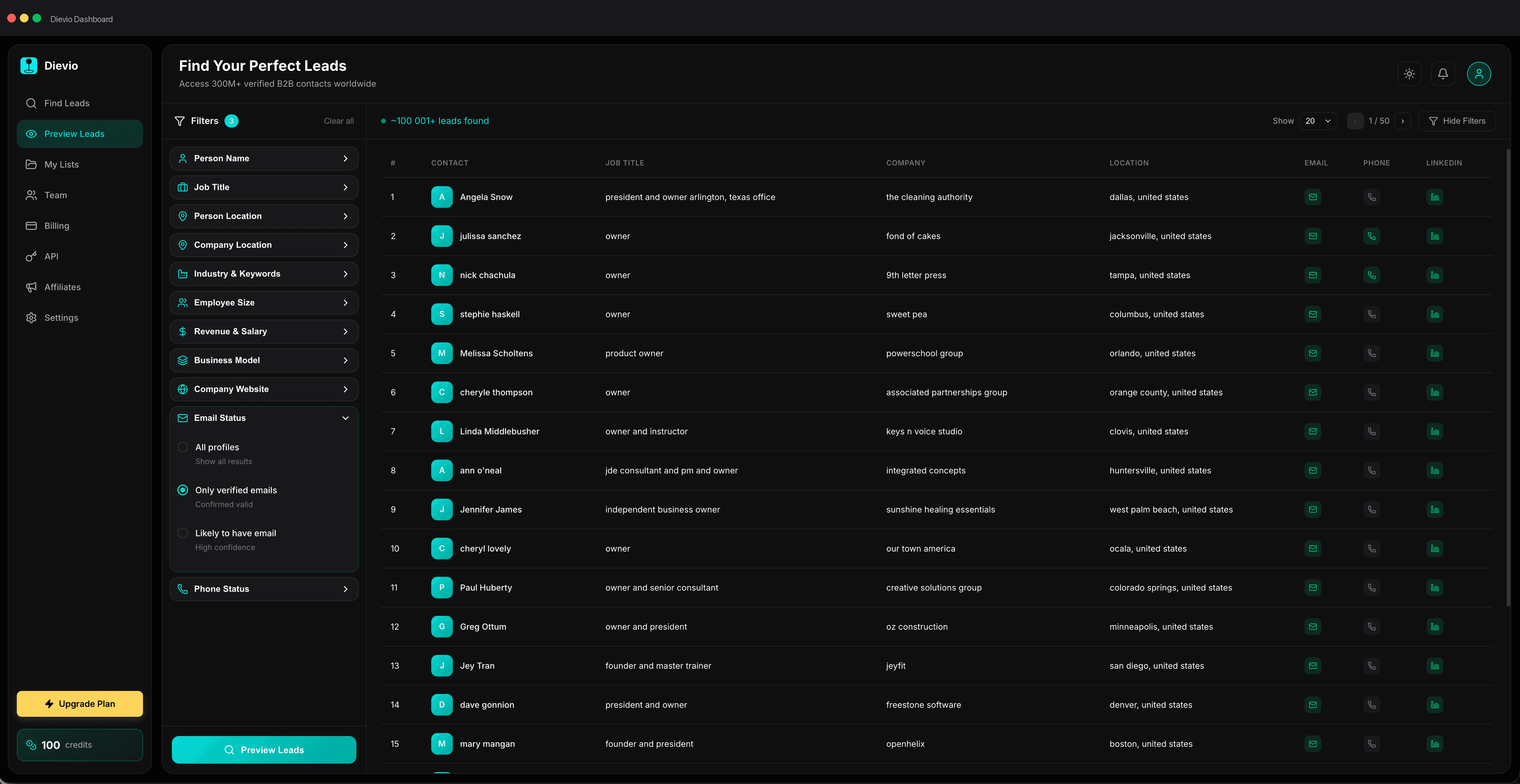
- Preview results before deciding whether you need more constraints.
If your result set is too broad, tighten gradually. If your result set collapses, remove the least reliable filter first, usually title complexity or over-specific tech assumptions.
Teams that want cleaner list design should spend time on filter combinations for faster list building. The point is not speed alone. It is building a repeatable way to isolate fit without losing usable market coverage.
One practical workflow is to use lead search with flexible prospecting filters for the first pass, then tighten based on what you see in preview. In financial services, list building improves when it is iterative, not when it is treated like a single export decision.
Data Fields to Prioritize and Validate for Financial Services
Once you have the right segment, the next step is to protect quality. Regulated verticals punish sloppy data because errors compound across deliverability, credibility, and workflow routing.
A simple validation framework
- Identity fields: Full name, current employer, current title, and profile recency.
- Account fields: Company name normalization, website domain, location, and business classification.
- Reachability fields: Email validity, phone availability if relevant, and duplicate status in your CRM.
- Compliance fields: Geography, suppression status, previous opt-out history, and restricted account flags.
- Campaign fields: Segment label, owner assignment, score, sequence eligibility, and source traceability.
In financial services, title validation matters more than many teams realize. Someone might be “Head of Operations” at a broker-dealer but own something totally different from a “Head of Operations” at a payments startup. That is why profile review on a sample set is still worth doing before scale.
You should also validate company registration signals and domain consistency where possible. Mismatched domains, outdated employer records, and legacy brand names create immediate trust problems in outreach. Email verification is equally important. There is no reason to expose your sending domain to a list that has not been checked for basic reachability.
For a deeper breakdown of what to inspect before buying or exporting records, review this guide to data coverage and accuracy validation. In practice, the best outbound teams treat validation as part of segmentation, not as a cleanup task after export.
Building the List: Step-by-Step Workflow
A repeatable workflow is what turns list building into an operating system instead of a one-off project. Here is a practical sequence that works well for financial services and FinTech teams.
1. Define the segment
Write the segment in one sentence. Example: “US and UK B2B payments companies with 50 to 500 employees, active partnership teams, and an operations or revenue systems buyer.” If the segment cannot be stated clearly, it will not be filtered clearly.
2. Set account-level filters first
Apply sub-vertical, geography, and size. This gives you the broad market frame before title noise enters the process.
3. Add role filters carefully
Layer in department and seniority. Use role logic broad enough to capture real buyers but specific enough to avoid flooding the list with adjacent teams.
4. Preview before export
Always inspect sample records. In regulated categories, previewing is not optional because title and company ambiguity are common. Using a workflow that supports segment previews helps you validate whether the search reflects the actual market you intended to target.
If you need that market-sizing step, preview lead counts before export so you can refine the segment before spending credits on a list that is too broad or too thin.
5. Run a validation pass
Check title consistency, company relevance, domain alignment, and contact method quality. Remove ambiguous records now, not later.
6. Apply hygiene rules
Deduplicate against CRM and previous exports. Exclude customers, open opportunities, suppressed contacts, and records already sequenced recently. Before any handoff, use a disciplined list hygiene checklist before export so reps are not working stale or conflicted data.
7. Add campaign metadata
Tag each record with segment, source date, owner, outreach channel eligibility, and campaign hypothesis. This is what makes later analysis possible.
8. Export into the right downstream system
Do not dump raw data into every tool. Decide whether the record should land in CRM first, enrichment workflow first, or sales engagement first.
The most important thing in this workflow is the order. Segment first. Validate second. Sequence third. A lot of poor outbound performance comes from reversing that order and asking reps to fix targeting problems manually inside a cadence tool.
Scoring and Prioritizing Your FinTech Prospect List
Not every valid record deserves the same urgency. Prioritization is where strong list work turns into efficient pipeline creation.
A practical scoring model
- Firmographic fit: How closely the account matches your ideal sub-vertical, size band, geography, and operating model.
- Persona fit: Whether the contact is likely to influence evaluation, implementation, or budget approval.
- Timing signals: Hiring, expansion, partnerships, product launches, funding, or team build-out.
- Data confidence: Whether the title, employer, and contact methods are strongly validated.
- Warmth: Referral path, prior engagement, event interaction, or existing relationship context.
The mistake here is overcomplication. A useful score does not need twenty variables. It needs enough structure to rank first-touch opportunities. If two accounts are equally good fits but one has fresher signals and cleaner data, sequence that one first.
That is also consistent with broader lead-scoring logic from LinkedIn Sales Solutions: scoring should help sales teams focus effort where fit and readiness are highest, not create a theoretical model nobody uses.
Connecting Your Lead List to Outbound Channels
A prospect list only matters if it enters a workflow reps can actually run. This is where many data projects lose value. The export is finished, but the operational handoff is messy, fields are inconsistent, and nobody knows which channel should go first.
A better model is to treat the list as the top of a multi-channel system.
Channel workflow example
- CRM sync: Create or update account and contact records with segment tags and source metadata.
- Email sequencing: Route only validated, eligible contacts into a channel-approved sequence.
- LinkedIn support: Use profile-based context for personalization and role confirmation before reps send connection requests.
- Phone usage: Reserve calls for priority accounts or later-stage touches where phone data quality supports it.
- Task orchestration: Trigger manual review tasks for high-value regulated accounts before launch.
HubSpot’s perspective on sales prospecting workflows is directionally right here: prospecting works best when it is systematic, not improvised. In financial services, that means connecting list quality to channel sequencing rules. Not every record should get the same cadence, and not every channel should be used by default.
For teams running more advanced operations, this is also where API-based workflows become useful. If your SDR team, RevOps team, or product-led motion needs programmatic enrichment and routing, a structured integration can keep your list logic consistent across systems. But even without automation, the key is simple: define what happens to a record after export before you ever export it.
Refresh Cadence: When and How to Update Financial Services Lists
Data decay is a universal B2B problem, but it is especially painful in financial services because role changes, reorganizations, and compliance ownership shifts can quickly invalidate a once-usable list.
Use a refresh cadence that matches the importance of the segment.
- High-priority active segments: Re-check every 30 to 60 days.
- Standard outbound segments: Refresh every 60 to 90 days.
- Long-term strategic account pools: Review quarterly for org changes, title shifts, and market events.
- Suppression and opt-out files: Update continuously, not on a batch schedule.
Also refresh when specific events happen: major funding, mergers, new market expansion, executive changes, product launches, or compliance leadership changes. Those shifts often change both buyer relevance and outreach timing.
If you are unsure whether a list should be refreshed or rebuilt, ask a practical question: has the segment definition changed, or has the data inside the same definition decayed? If the market is the same, refresh. If your thesis about the buyer has changed, rebuild.
Common Mistakes to Avoid in FinTech Lead List Building
Most list failures in regulated markets are operational, not theoretical. The same problems show up again and again.
- Starting with volume instead of ICP clarity. More contacts do not fix a weak segment definition.
- Using broad “financial services” filters without sub-vertical logic. That usually creates mixed lists with weak messaging relevance.
- Assuming title equals buying authority. Financial services buying committees are often more distributed than teams expect.
- Skipping suppression, deduplication, and CRM checks. This creates internal friction and external trust issues fast.
- Pushing unvalidated emails into outreach. Bad data quality damages deliverability and wastes rep time.
- Treating compliance as a final review step. By then, the segment design may already be flawed.
- Failing to tag records by source and segment. Without that, it is hard to learn what actually works.
The pattern behind all of these mistakes is the same: teams move too fast at the export stage and too slowly at the thinking stage.
Final Take: Build Financial Services Lists Like an Operator, Not a Scraper
The best b2b lead lists for financial services are not the largest. They are the most usable. That means they reflect a clear ICP, a compliance-aware workflow, validated contact data, and a handoff process that fits how your outbound team actually sells.
If you are building in FinTech, payments, banking infrastructure, lending, wealth, or insurance, list quality is not a support activity. It is one of the main levers behind conversion efficiency. Better segmentation improves replies. Better validation protects deliverability. Better workflow design protects rep time.
If your team wants a faster way to move from ICP definition to clean exports, Dievio can help you search, preview, and refine segments before launch. Start with Dievio’s lead search workflow for B2B prospecting to build targeted lists with flexible filters, or use previewing first when you need to test market size and coverage before committing. For outbound teams selling into regulated industries, the right process is usually simple: narrow the market, validate the data, and only then scale outreach.